Saturday, April 25, 2026

Super El Niño 2026 vs India's Climate Reality: Understanding the Ocean's Impact

Super El Niño 2026 vs India's Climate Reality: Understanding the Ocean's Impact

What is El Niño & Super El Niño 2026
I was watching news channels the other day, and almost all of them were talking about El Niño like some monster emerging from the ocean to burn the summer even harder. This is not new—media often amplifies scientific events into dramatic narratives. But what it does, interestingly, is create two parallel responses at the same time: public anxiety and scientific curiosity. People who come from geography or environmental science backgrounds, especially those preparing for exams like UPSC, NET, already have some clarity about this term. But for a large section of people, El Niño still sounds like something mysterious, unfamiliar, and slightly threatening.
 
Scientifically, El Niño refers to an abnormal warming of surface waters in the central and eastern parts of the equatorial Pacific Ocean. The term “El Niño” comes from Spanish, meaning “The Christ Child,” because a fishermen near the coast of Peru noticed this unusual warming of ocean water appearing around December. That’s the basic definition. And when this warming crosses a certain threshold—usually when sea surface temperature deviates and go beyond about +2°C compared to normal temprature—it is often called a “Super El Niño.” In simple words, a Super El Niño is just a stronger, more intense version of the same phenomenon, but its effects are slightly bigger and unpredictable.
 
Under normal conditions, trade-winds blow steadily from east to west across the Pacific, pushing warm surface water toward Southeast Asia and Australia but during an El Niño phase, these winds weaken, and sometimes even shift direction slightly. As a result warm water spreads back toward the central and eastern Pacific. This redistribution of heat changes the atmospheric pressure patterns. And that begins to disturb global wind systems and rainfall cycles. Temperature-wise, even a 1–2°C rise in ocean surface temperature may sound small, but because oceans store massive amounts of heat, this small change is enough to influence weather across all continents.
 
El Niño is not a storm, not a season, and not a singular event—it is a phase within a larger climate system known as the El Niño–Southern Oscillation (ENSO). This system represents a periodic fluctuation in sea surface temperatures (SSTs) and atmospheric pressure across the equatorial Pacific Ocean. That means El Niño is part of a cycle, not an isolated problem. It develops over months, sometimes lasts for a year or more, and interacts continuously with the atmosphere.
In other words, We are dealing with here is not a sudden event, but a slow-moving shift in the ocean–atmosphere system that quietly reconfigures the global climate landscape. And that is why something happening thousands of kilometres away in the Pacific can still effects how hot our summer feels or how strong our monsoon arrives. 

 La Niña — The Opposite Phase for Conceptual Clarity 

 To really understand El Niño, we need to understand its counterpart, because without that distinction the concept remains incomplete. This opposite phase is called La Niña, a Spanish term meaning “The Little Girl,” and it represents the cooler side of the same ocean–atmosphere system. If El Niño is about abnormal warming in the central and eastern Pacific, then La Niña is about abnormal cooling in that same region. But again, the concept is not just about temperature—it is about how this temperature shift reorganises winds, pressure systems, and rainfall patterns across the globe.

Under La Niña conditions, the trade winds do not weaken—they strengthen. These stronger winds push even more warm surface water toward the western Pacific, near Indonesia and Australia. As a result, colder water rises more intensely from the depths along the eastern Pacific, near South America. This process is called upwelling, and it enhances the cooling effect. Now think about what this means at a system level. The temperature contrast across the Pacific becomes sharper and the atmospheric circulation intensifies, and rainfall patterns shift accordingly. wet Regions are tend to get wetter, and dry regions can become drier—but in a different spatial pattern compared to El Niño.

For India, this distinction becomes very important. La Niña years are generally associated with stronger and more reliable monsoons. The same atmospheric circulation that weakens during El Niño becomes more active during La Niña, supporting cloud formation and rainfall over the Indian subcontinent. That is why, historically, many La Niña years have coincided with above-normal monsoon rainfall.

But this does not mean La Niña is always beneficial.

Stronger monsoons can also lead to floods, landslides, and crop damage in certain regions. So the distinction is not between “bad” and “good,” but between two different modes of imbalance within the same system. In other words, El Niño and La Niña are not dangerous and mysterious Pokemon—they are phases of a single oscillating system, like two ends of a pendulum. One shifts heat toward the eastern Pacific, the other pulls it back toward the west. One weakens atmospheric circulation, the other intensifies it. And between these two extremes lies what scientists call the “neutral phase,” where conditions are closer to average. That is the deeper conceptual clarity—what we often treat as isolated climate events are actually expressions of a continuous and dynamic oscillation.

Super El Niño2026 vs India's Climate Reality

Climate systems do not operate in isolation. They are connected through what scientists call atmospheric coupling—a process where the ocean and atmosphere continuously exchange heat, moisture, and momentum, forming a single, interlinked system. To simplify it, imagine the Earth’s climate as a set of invisible conveyor belts made of air currents. These currents move heat from one region to another, maintaining a kind of global balance. One of the most important of these is the Walker Circulation—a large-scale loop of air movement across the equatorial Pacific.

Under normal conditions, warm air rises over the western Pacific (near Indonesia), creating low pressure and heavy rainfall there. This rising air then travels eastward at higher altitudes, cools, sinks over the eastern Pacific, and returns westward near the surface as trade winds. This loop indirectly supports the Indian monsoon by maintaining a stable distribution of heat and pressure across the tropics.

Now introduce El Niño into this system. When the central and eastern Pacific becomes unusually warm, the region of rising air—what we call convection—shifts eastward. Instead of strong upward motion near Indonesia, it starts happening more toward the middle of the Pacific. As a result, the entire Walker Circulation weakens or becomes displaced.

This is where the Indian monsoon starts to feel the effect.

The monsoon depends on a pressure difference between the hot Indian landmass and the relatively cooler surrounding oceans. But during El Niño, because a significant amount of heat and convection has shifted toward the Pacific, the atmospheric energy available to drive monsoon circulation over India reduces. The rising air that would have helped form rain-bearing clouds over the subcontinent is now occurring elsewhere. In simple terms, the system that normally pulls moisture-laden winds into India becomes weaker. That is why El Niño years are often associated with delayed monsoons, reduced rainfall, or uneven distribution of rain across regions. Not always, but often enough to establish a pattern. Now when we talk about a “Super El Niño,” the same mechanism operates—but with greater intensity. The warming in the Pacific is stronger, the shift in atmospheric circulation is more pronounced, and the disruption to global weather patterns becomes deeper.

India’s climate is not controlled by El Niño alone. The Indian Ocean Dipole (IOD), local sea surface temperatures, Himalayan snow cover, and even land-use patterns also influence the monsoon. That means El Niño increases the probability of a weak monsoon, but it does not guarantee it. Because when we hear “Super El Niño 2026,” it is easy to assume a fixed outcome—a failed monsoon, extreme heat, or drought. But in reality, what it represents is a shift in probability, not certainty. The system becomes biased toward certain outcomes, but it still retains variability.

And that is exactly what makes this both scientifically fascinating and socially unsettling—the fact that a slow warming in the Pacific Ocean can tilt the entire climate balance of a region like India, not by force, but by altering the invisible architecture of air itself.

India Under a Super El Niño — The Real Implications

A Super El Niño does not hit India as a single disaster—it shows up as a chain of linked problems across monsoon, temperature, agriculture, and the economy.

The first impact is on the monsoon. With weakened atmospheric circulation, rainfall tends to be lower or poorly distributed. It may arrive late or pause in between, or concentrate in short bursts instead of steady raining. This uneven behaviour matters more than just total rainfall, because crops depend on timing as much as quantity.

Kharif crops like rice, pulses, and oilseeds rely on consistent early monsoon rains. A weak or erratic monsoon reduces the soil moisture and delays sowing, and lowers yield. But the effect is not uniform across India, but the overall risk increases.

Temperature is the second layer of the onion. El Niño years usually push global temperatures upward and over India this often translates into longer and more intense heatwaves. Higher day temperatures combined with warmer nights reduce recovery from heat stress, affecting both human health and crop productivity.

Water stress builds quietly in the background. Reduced rainfall means lower reservoir levels and faster groundwater depletion, especially in already vulnerable urban regions. This does not always create an immediate crisis, but it tightens supply over time. All of this feeds into the economy. Lower agricultural output can drive food inflation, particularly for staples. Rural income weakens, and sectors linked to agriculture feel the pressure. The impact is gradual but widespread.

In simple terms,

a Super El Niño does not create one extreme event—it shifts the baseline of multiple systems at once, making the climate more unstable and less predictable across India.

Monday, October 1, 2018

The Aurora or the Polar Lights

The Aurora or the Polar Lights

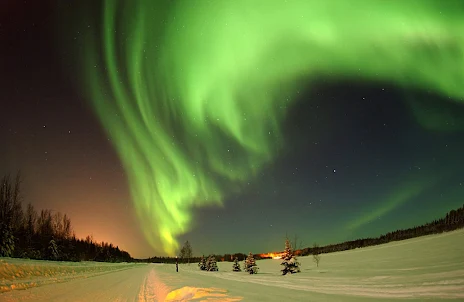
The AURORA or we also Known as a "The Polar Lights", The Northern Light (Aurora Borealis) or The Southern Light (Aurora Australis) are one of most beautiful displays of nature. Apart from these, "Black Aurora or Anti-Aurora", "Electron Aurora", "Proton Aurora", etc.... are also.. If this is done in depth study then this topic is quite big but i'm just giving an overview of them. So.....There are mainly two types of aurora :-

  1. Diffuse Aurora.
  2. Discrete Aurora.

 Other planets have their own aurora but in this article I'm just writing about Earth's Aurora. In ancient times, people thought that the spirits of their ancestors can be seen dancing within the light of the aurora. In Norse Mythology the Vikings believed that the aurora was a bridges of fire to the Asgard and other says they're the light reflected of the Valkyrie's shields and people in Finland thought it was the Archangel Michael and John Travolta fighting with the Devil. And many other kinds of superstitions were spread out But they're all wrong and myths, They are actually caused by The SUNFirst of all Galileo Galilei gave the Northern Lights their name "The Aurora Borealis" which is a Latin name and which mean "Dawn of the north" But he couldn't tell the reason behind this phenomenon. But in 1896 a Norwegian scientist Kristian Birkeland explain the reason behind this why does it happen. Well as we know that....our sun is a gigantic massive ball of "Plasma", and every once in a while it kicks up a bit of a Solar storm., and the Sun generates its energy by nuclear fusion of "H"-nuclei into "He", using the process of nuclear fusion .the sun is able to turn small amount of matter into a enormous quantities of energy .It's how the sun has managed to keep producing energy for billions of years without running out of fuel. This plasma around the sun generates huge magnetic fields. The magnetic field is forced outwards into space at great speeds, taking extremely hot gases and charged particles with it, this is known as a "Solar Flare" and they can be witnessed on the sun's surface as a very bright spot followed by a cloud of gas .When  a very large solar flair occurs containing a significantly huge amount of energy ,it referred to as a "Corona Mass Ejection", or "CME" for short.
Coronal mass ejection(CME)-The Aurora or the Polar Lights
Coronal Mass Ejection (CME)
The gas clouds produced by a CME can sometimes be larger then the sun itself, its doesn't stop charged particles ejected from the sun continue to travel outwards through space over enormous distances, After traveling through space  for almost two days they will reach on earth ,this is known as the
"Solar Wind" and it can be extremely dangerous ,if a CME were hit our planet earth it could the extinction of the all races on the earth including humans. now that  a question is striking in your mind ,"why hasn't it".....well the solar wind regularly hit earth ,often ,but  we have a defense system to protects us from the huge bombardment of the son, earth produce its own magnetic field because at the earth's core is a ball of solid iron ,the heat of this iron turns the surrounding outer core into flowing liquid iron the movement of this outer liquid core produces a magnetic fields, this protective barrier is called the "Earth's Magnetosphere"  and it extends more then 600,000 kilometers (370,000 miles) from Earth which protect us from all sorts of HARSH Forces (not my friend Harsh vardhan because this disaster being is damn awesome ) that come from far away in space including solar flares. Most of the Sun's solar winds simply bounce off the earth's magnetosphere when it reaches us however the magnetosphere has two weak spots,at south pole and north pole thats why very small percentage of charged  particles that come from the sun, and enter in earth's atmosphere via the two weak spots. When this happens the electrons in solar wind collide with oxygen & nitrogen in the atmosphere. During this, energy is transferred from the solar wind to nitrogen and oxygen atoms and raised it up from there normal state to exciting state ,when it's happen atom's electron move into an orbit further away from the nucleus. These newly exited atoms release their energy to return their normal state, atoms release their energy in the form of photons which we see as the light which we call Aurora. Different elements gives different color for example; Ionized nitrogen will produce Blue color, whereas neutral nitrogen molecules produce Purple-Red color and oxygen molecules cause the Green color and oxygen atoms cause the red color  displays. simply... the color of emission line spectra depends on the chemical composition, and each type of atom produces its own unique color. and even, it is also produce sounds, there are generally two types of sound the first one is swishing sound that change with movement in that auroral display and the second one is crackling sound, like static electricity makes.

Monday, September 3, 2018

Relation between Black hole,White hole & Wormhole and What are these


Technically any object whose radius is smaller than its Schwarzschild Radius is called a "Black Hole" and Every galaxy has a super massive black hole at the center of it, The closest super massive black hole to Earth is about 27000 light year away in the center of our galaxy. It's name is " Sagittarius A* " (Coordinates: RA 1h 11m 3s | Dec -29° 0′ 28″..... when a star runs out of fuel and it can no longer keep itself hot enough, it collapse to a single ,smallest point, which known as a "Singularity" . And it's outer surface generally called the "Event horizon", this is a place between Singularity & Space . According to Professor Kip Thorne (California Institute of Technology)-"Event Horizon is not made of matter, it's just a unique location, where gravity is become so strong and just inside them that nothing can escape".Because a black hole is an object which escape velocity is more then the speed of light if we wanna make a black hole we must have the any mass equal or above to Planck Mass, because smallest mass of a black hole is approximately the Planck Mass. simply we can say that when a star dies, it become a Gravitational Ghost, called "The Black Hole". A Black hole not actually a hole and it doesn't suck anything, because suction is caused by pulling something into a vacuum. According to the NASA scientists a black hole is a place where Gravity pulls so much that even light  can't get out, So we can't able to see a black hole. According to the Einstein's theory of General Relativity, Space-time fabric is like a rubber sheet not a solid surface and Gravitational Field bends the space-time fabric.But, In my opinion, Our sensory existence is limited to the three dimensions that's why space-time is almost impossible to inspect or observe and a black hole is actually an absence of space-time because according to the Einstein theory, gravity causes displacement of space-time..! so absence of space time must be pure gravity.This enormous gravity of black hole is due to the density of it. because matter has been squeezed into a tiny space. In this sense when light comes behind a black hole then it's outstandingly distorted this effect called "Gravitational Lensing"
"Gravitational Lensing"


Mainly there are three type of black holes on the basis of there size :-

  1. The first type is a tiny one it may be as small as just one atom, called "Primordial Black Hole" or "PBH" for short. They have extremely small Schwarzschild Radius and its density at the size would be so high. Therefore scientists say that they born in the beginning of our universe(During BIG BANG) when the density was extremely high.
  2. The second one is called "Stellar Black Hole" or "SBH", Which have about 20 times of solar mass. They have about 1018 kg/m3 of density and they are much bigger then a PBH. That's why they have bigger Schwarzschild Radius and less density then a PBH. They born when a star die or two neutron star collides.
  3. The third one is called "The Super Massive Black Hole " or "SMBH" these type of black holes are the largest black holes. It have mass about one million times of solar mass but comparatively they have lower density and high Schwarzschild Radius then SBH. They lurk in the heart of galaxies. For example :- "Galaxy NGC4889" have a SMBH in the center of it..... which have up to 21 billion of solar mass. 
and some other types of black hole are; Charged Black Holes, Virtual Black Holes, Kugelblits Black Hole, Naked Singularity, Spinning Black Holes & Non-spinning Black Holes.
  • Charged Black Holes:- As the name gives information about it. A charged black hole have enormous amount of electric charge. They have two Horizon (1). Event Horizon. (2). Couchy Horizon.
  • Virtual Black Hole :- These black holes are temporary. And they born as a fluctuation of quantum space time.
  • Kugelblits Black Hole :- A Kugelblits Black Hole created by the collapsing of photons and this is the hottest thing in the universe.
  • Naked Singularity :-This is a Gravitational singularity without an Event Horizon and technically it is observable.
  • Spinning or Rotating Black Hole:-They also known as "Kerr black hole". We know that singularity is a infinite small point of a black hole, with no surface area.
    A Spinning Black Hole
     But rotating singularity can't be a point because point can't rotate, So....... as an alternative it's have shape of ring. We can say it a "Ringularity", which containing all the mass of the black hole. Just like singularity , ringularity also have no surface area and zero thickness. A ringularity creates a new region of space-time, called "Ergosphere".Ergosphere surrounds black hole in the center of it. In another words , Ergosphere is just like a sheathe, which covers the black hole. These type of black holes has Two surfaces of horizon, (1) Event Horizon (Outer Surface) (2) Couchy Horizon(Inner surface). And these Horizons are Topologically (Not Geometrically) spherical because these surfaces continuously formed and deformed.
      
    Spinning Black Hole's Diagram

    According to the Ricci Scalar (Scalar curvature) The curvature of the inner horizon is always negative throughout poles. But the curvature of Outer Horizon at the poles is negative but curvature of the equator is positive. It is assumed Spinning black hole transfers it's own kinetic energy in the form of rotation. So when we give some mass energy, it gives us some rotational energy. . To understand this concept let's take a example, When an object enters in a whirlpool, so the whirlpool pulls it inside it....... but not directly, it is sucked through spinning water current ,in this rotating area water current pulls that thing towards the water's direction. On the basis of this fact "Roger Penrose" theorized a creepy mechanism to extract this Rotational energy from a Spinning Black Hole, called "Penrose Mechanism". And another important theory is "Blandford-Znajek Process" , Theorized by "Roger Blandford" and "Roman Znajek" in 1977, in this process the concept of Horizon surface is replaced with the concept of Electromagnetic Active medium. 
  • Non-Spinning or Non-Rotating Black Hole :-They also known as a Stationary Black Hole or Schwarzschild Black Hole. They would have to be created with material, having no angular momentum. But Non Rotating Black Hole are not likely to actually happen.
    In my opinion may be these are also rotate with a negligible speed of momentum or almost zero angular momentum.
  •   
But the shocking fact is the average density of a black hole can be lower then the water because black hole surrounds Singularity at the center of it. Everything that has ever fallen into the black hole is destroyed at the singularity. Black holes radiate there mass away as a radiation called "Hawking Radiation", but this process extremely slow, and this process happening constantly .the more the black hole loses the mass, the hotter it become and the faster it evaporates until they have a "Hawking Temperature". The peak wavelength of this radiation is nearly 16 times the Schwarzschild radius of the black hole..Everything that falls into the black hole is stored on its event horizon , So.......according to the Hologram theory , black hole is a hologram because everything inside is encoded on its event horizon but a person who fall inside a black hole wouldn't reading that they're encoded on a flat surfaces.
 Recently, two neutron star collided 130 million years ago and this greatest event was detected by LIGO-VIRGO. this observation done on August 17 , 2017 at 08:11 AM even this is a solid proof of a kilonova, A precious metal which can make Earth's of gold silver platinum ...etc. LIGO data revealed that the object created by the neutron-star merger is about 2.7 times the mass of the sun. It is therefore  either the lowest-mass black hole ever identified. This video is first LIGO/Virgo detection of a binary neutron star merger (GW170817).


WHAT HAPPENS  WHEN SOMETHING FALL IN A BLACK HOLE:-

Imagine when a person or for example my friend "Junaid Ahmed" wanna  go to the another galaxy but he accidentally get closer to the black hole's  gravitational area he get sucked into it with the speed of light instead, he experience his further journey become...slower, slower and slower until he reach  the event horizon. During this he would look as if the black hole diminishingly  away from him, Because his field of view would highly increased, in this sense..... Junaid would able to see almost everything behind him and suddenly he would see the black hole just front of his eyes. After that he become increasingly red shifted. After it the closer he get to the singularity the more power of gravity he experience ,this effect called "Tidal Force" and which body part are closer to the black hole, would be pulled more strongly to the singularity in this consequence the entire body of my friend would be stretched towards the singularity this process known as "Spatighittification". During Spatighittification effect which caused by tidal force every molecule of the body would be stretched until they torn apart. During this my friend who is almost 6 feet guy, become 600 feet or may be more taller for a moment.

WHEN TWO BLACK HOLES COLLIDE :-


The Galaxy NGC 6240 has two super massive black holes at the center of it. Scientists believe that one day these black holes may very well collide with each other.
the collision of two black holes is such a rare and the disastrous eventthere's basically two possible results.which possibility depends on the speed at which the two black holes are traveling. If the two black holes are spinning at extremely high speed and come together at just the right angle, the smaller black hole will be catapulted away from the bigger black hole. But the second one is more likely outcome is that they will slowly come closer and closer together, until they become collapsed. this scenario would be incredible. After that the resulting black hole is known as a "Binary Black Hole". as the two black hole start to merge they would appear to be distorted mass of matter. But as they come closer together the resulting black holes through a process known as "Ring-Down".this is when any distortion in the shape is slowly deformed and the new binary black holes becomes more circular. until any asymmetry is lost and the black hole, become larger then ever before. The energy emitted from the collision would be incredible..... it would spread ripples through the space-time fabric of the universe. these ripples are are known as "Gravitational Waves".

Check this out; GW170814
                                                             Two Black Holes Colliding Signals detected by LIGO

THE WORMHOLE:-


The Wormholes were theorized by "Einstein" and "Nathan Rosen" ,as part of  theory of general relativity.they also called "Einstein-Rosen Bridges".And are thought of as holes through space-time fabric.Simply........Wormhole is a shortcut of two opening at different points in space-time with an invisible tunnel between the two points. Many scientist believe that, Its one end is a black hole and other on is a white hole and this is a way of Multiverse . One Russian researcher believe that he could spot them with a radio telescope .....but until now, it's never been done.Even scientists of "Autonomous University of Barcelona" have created a "magnetic wormhole", that transfer the magnetic field through an extra spacial dimension. This Magnetic Wormhole Made by "Metamaterial" but this isn't space-time wormhole.but they are a similar concept. Space-time wormhole are manipulation of gravitational force, and magnetic wormholes are manipulating electromagnetic force. this is possible by using metamaterials the scientists were able to create a tunnel using metamaterials .while normal space-time wormhole connect two points in this or other universe through an unseen bridge but this wormhole connect two magnetic fields through an unseen bridge!........A normal magnet has two poles ,north and south pole and they are opposed ,with a magnetic fields connecting them . In this case the Magnetic wormholes separates the poles and singling them out, and Creates a monopole but researcher can't tell where the magnetic field connects those monopole and this device makes a monopole into existence with no detectable connection to that pole on the other sides they hide a magnetic field's distortion from the outside by using metamaterials. through a magnetic wormhole we couldn't send physical matter but we could send magnetic wave from one point to another point. Like this, Scientists was also created a "Dumb-Hole", which theory was proposed by "William Unruh In 1981". A Dumb hole doesn't allow sound to escape. It's also called a Sonic Black Hole or Acoustic Black Hole.  
In 2006 
Mohd. Mansouryar
Iranian Physicist "Mohd. Mansouryar" was claimed to that he creates a nano sized wormhole and his theoretical wormhole would exist on Planck scale and he believe, He could build a ring of several of them with the space in between collapsing and forming a larger wormhole. But for the creation of this we required The "Exotic Matter" which have the negative mass. Because positive mass is attractive because of gravity but negative mass would be repulsive, and it's make a kind of anti-gravity . Because experts thinks that The Exotic Matter must deploy extreme pressure to neutralize the gravitational force and push space-time open, in another words this kind of matter use to stabilize the wormhole.


THE WHITE HOLE:-


A White Hole
this is just opposites of black holes they force out light and matter and prevent it from entering whereas black holes devour light and matter and prevent it from escaping. some expert even say that the Big Bang itself was a "White Hole". In this sense we could be living in a black hole. We think that white holes and black holes might be entrance of a Wormhole. when something fall in a black hole , scientists call it "information". According to the Low Of "Conservation of Mass" it can't be created and destroyed, it can only change into the other form. So in the black hole, all physical states convert into the same state , this is called "The Black Hole Information Paradox", which is the resulting from the combination of Quantum Mechanic and General Relativity. And this information would be locked in to the Singularity of the Black hole for the infinite time. So the black hole can turns into the "White hole". And this newly born White Hole spews out all the Information. But this topic is controversial because according to the Hawking Radiation Theory, which I have already mentioned. So there is still debating in the physics community about this. In 2006 an extraordinary long lasting Gama Rey burst was observed which was 102 second long. But there was no Any other known cosmic event. The scientist who observed this event said "This is brand new Territory and we have no theories to guide us". but after that in 2011 scientists had said that this Gama burst was come from a White hole which was popping out into existence for 102 seconds and then disappeared .

Super El Niño 2026 vs India's Climate Reality: Understanding the Ocean's Impact

Super El Niño 2026 vs India's Climate Reality: Understanding the Ocean's Impact   What is El Niño & Super El Niño 2026 I was wa...